
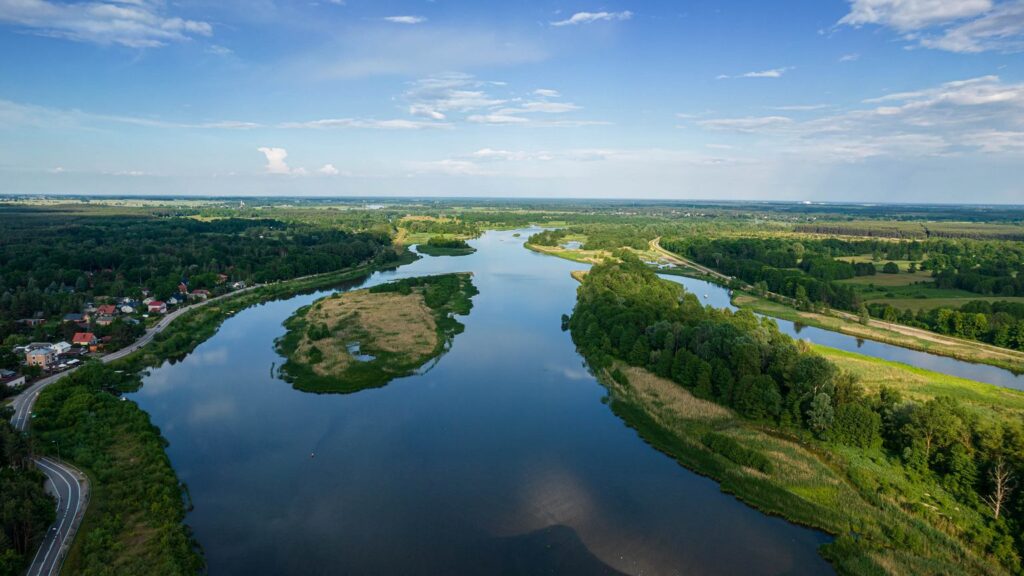

The Bug River is one of the last large wild rivers in Europe. Its valley is also one of the least discovered and most beautiful places in Poland. A weekend or holiday trip to the Bug River is a great idea both for those looking for an active way to spend their free time and for those whose goal is to relax in silence, surrounded by wild nature. Getting to the Bug River from Warsaw should take no more than an hour, which means that even if you only have a weekend available, you will still have enough time to experience at least a little of the atmosphere of this unique river.
1. How Does the Bug River Flow Through Poland?
The Bug is the fourth-longest river in Poland. It flows through the eastern part of the country. The total length of the Bug River is 774 kilometres, of which 587 kilometres run through Poland. The source of the river is located in Ukraine, in the village of Verkhobuzh in the Podolian Upland.
The Bug forms part of the border between Poland and Ukraine, as well as Poland and Belarus, from the village of Gołębie to Niemirów, where it ceases to be a border river. Continuing north, the Bug flows through the southern part of the Podlaskie Voivodeship and then enters the Mazowieckie Voivodeship. The Bug also flows through the eastern part of the Lubelskie Voivodeship. The mouth of the Bug into the Narew is located near Serock, close to the Zegrze Reservoir, one of the most popular places among Warsaw residents for one-day trips and short getaways.
Towns and villages located on the Bug River at a relatively short distance from Warsaw include Małkinia Górna, Brok, Brańszczyk, Kamieńczyk, Wyszków, Popowo Kościelne, Kania Polska, and Arciechów.

The course of the Bug acts as an important ecological corridor — the river valley is characterized by diverse fauna and flora. Nearly 100 species of butterflies live here, which accounts for 70% of all butterfly species found in Poland.
2. Where Does the Bug River Start and Where Does It Flow?
The Bug River flows through the territories of three countries: Poland, Ukraine, and Belarus, partly forming a natural border between them. The river begins its course in the Podolian Upland in Ukraine and ends as a left tributary of the Narew, flowing into the Zegrze Reservoir, considered one of the most beautiful places in Mazovia and eagerly visited by both residents of nearby towns and tourists.
The largest part of the Bug River is located within Poland. Because the Bug was not taken into account in spatial development plans for a long time — both on the Polish side and on the side of the former Soviet Union — the river has remained wild and unregulated. As a result, we can still admire long stretches of riverbanks shaped without human interference, serving as a refuge for wild birds and many plant and animal species, including protected ones. Along the river there are several important areas belonging to the Natura 2000 programme, including Special Areas of Conservation and Special Protection Areas for birds. The most important ones include:
- the Middle Bug Valley,
- the Polesie Bug Valley,
- the Western Volhynian Bug Valley,
- the Lower Bug Valley, which is part of the Nadbużański Landscape Park.
These are areas of high biodiversity, providing shelter for many rare and endangered species of birds, fish, mammals, amphibians, insects, as well as valuable habitat types such as riparian forests, flood meadows, oxbow lakes, and other river ecosystems. The Bug Valley also serves as an important ecological corridor of European significance, enabling species migration and connecting different regions.
3. Is the Bug River Deep?
The Bug is a river with very varied depth, which fluctuates depending on the section, season, and current water level.
The upper course of the Bug is fairly shallow, and the river depth in this part usually does not exceed 1 metre. In the middle course, the depth typically ranges from 1.5 to 2.5 metres, although in some places it may reach even 3–4 metres. The lower course of the Bug is the deepest — in some places the water reaches a depth of 5 metres, and according to some sources, even 8 metres. Importantly, the depth of the river changes dynamically, which should be kept in mind when planning activities by the Bug. The river has both shallows, where it may almost be possible to cross to the other bank, and deep holes, while places that were shallow some time ago can quickly become dangerously deep. When enjoying the river, you should always be careful, even if you are in a place you already know.
4. Is the Bug River Clean?
Assessing the cleanliness of the Bug River is complex and depends on many factors, including the section of the river being tested and the parameters being examined.
The Bug is not among the cleanest rivers in Poland, which results from several factors. The condition of the water in the Bug is significantly affected, among other things, by transboundary pollution from Ukraine and Belarus, where the discharge of municipal and industrial wastewater into the river is not uncommon, while international efforts aimed at improving water quality are insufficient. Coli bacteria are detected relatively often in the waters of the Bug, which means that in many sections the water is classified as below standard in sanitary terms. In addition, high concentrations of organic and microbiological pollutants, as well as nutrients such as phosphates and nitrogen compounds, are detected in the waters of the Bug. However, improvements in water quality are already being observed in some tributaries of the Bug thanks to investments in wastewater treatment plants.
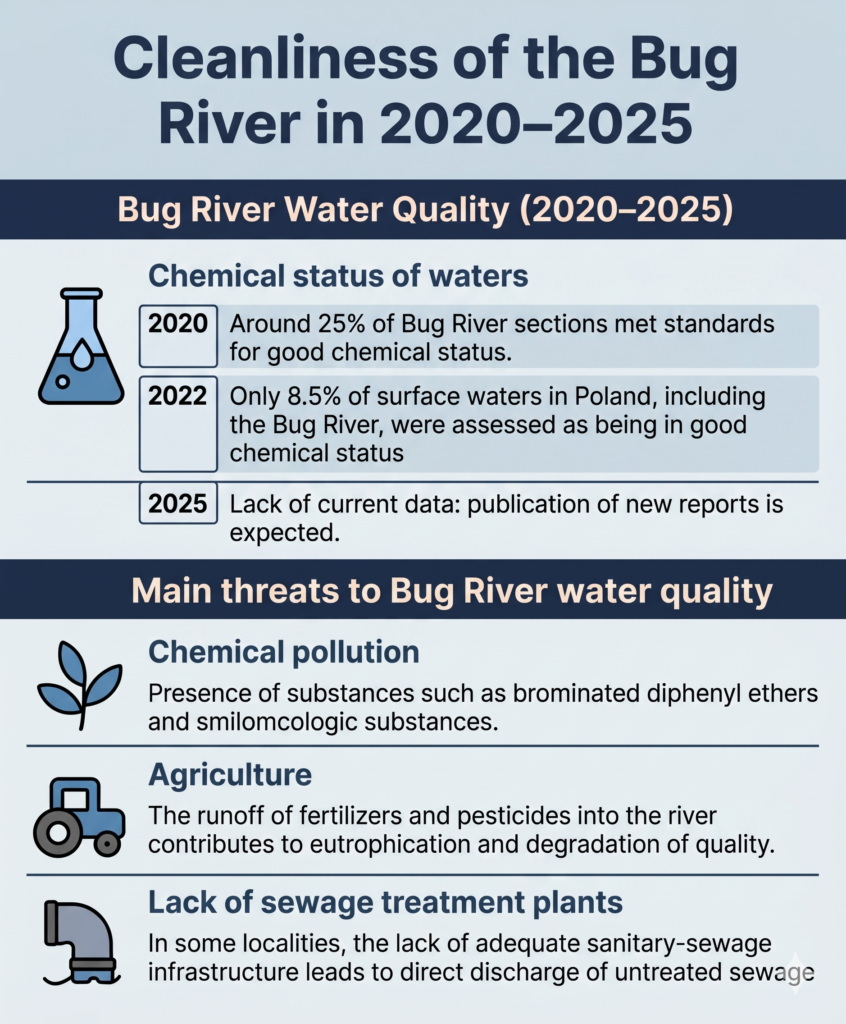
The water quality in the Bug is subject to regular inspections, which make it possible to confirm local improvements. This is demonstrated by local tests carried out at the bathing area on the Bug River in Drohiczyn, which showed that the water met the requirements set out in the Regulation of the Minister of Health of 17 January 2019. A water sample taken on 13 August 2024 was deemed suitable for bathing in terms of microbiological testing and organoleptic assessment.
Initiatives aimed at improving the cleanliness of the river are becoming more frequent, such as the “Operation Clean River” clean-up campaigns.
Importantly, despite problems with water quality in the Bug, the Bug Valley remains a valuable natural area.
5. Does the Bug River Flow Into the Narew?
On some older hydrographic maps, the Bug was treated as the main river and the Narew as its tributary. Today, despite being longer than the Narew, the Bug is considered its tributary. Just before Serock, the Bug flows into the Narew, and their waters form the Zegrze Reservoir — a large artificial lake created after the construction of the dam in Dębe in 1963. The Zegrze Reservoir, also known as Lake Zegrze, is located about 30 km north of Warsaw, in Legionowo County. It is a very popular recreational destination, mainly because of the large number of local attractions, including:

- numerous beaches and bathing areas,
- opportunities for water sports, such as sailing, windsurfing, kitesurfing, kayaking, pedal boating, and SUP,
- fishing — the reservoir is rich in fish such as zander, eel, bream, roach, and white bream,
- walking and cycling trails,
- historic sites and other interesting places, including Zegrze Fortress, the ruins of the Szaniawski Manor House in Jadwisin, and the Parish Church in Serock.
Another advantage of the reservoir is its relatively short distance from Warsaw and its easy accessibility, both by car and by public transport.
6. The Bug River — Interesting Facts
The Bug River, with its history, wildness, and natural wealth, remains largely not fully explored, and many facts about it are not widely known. Among the interesting facts about the Bug, it is worth mentioning that in the past the river was an important transport and trade route connecting different regions, and traces of former navigation are still visible in the form of existing ports and marinas.
Many places along the Bug are also associated with legends about sunken treasures hidden by retreating armies or monks. During wars, people would sink valuables in the river to retrieve them later — not always successfully. Flowing through Poland, Ukraine, and Belarus, the Bug is one of the most important border rivers in Europe. Interestingly, in some villages along the Bug you can see bilingual or even trilingual information boards and meet residents who speak Polish, Ukrainian, Belarusian, and even dialects from the cultural borderland.
One characteristic feature of the Bug is the lack of bridges on many border sections, while in some places there are bridges that are opened only occasionally, for example for pilgrimages, or remain closed. In addition, cable ferries operate on some sections of the river, serving as the only way for local residents to cross to the other bank and as a major attraction for tourists.

It is also worth noting that the Bug River often appears in literature and poetry as a symbol of the border between East and West, as well as the boundary of civilization — Slavic, Christian, or European. The Bug is also mentioned in ballads, soldiers’ songs, and folk songs. It is also used as a backdrop in historical and war films.
7. Holidays by the Bug River
A holiday by the Bug River is a very interesting idea for contact with nature and peaceful relaxation or active recreation, depending on your expectations and needs. The picturesque Bug Valley encourages exploration of the surrounding area, offering numerous ways to spend free time. The most interesting include:
- water activities, such as kayaking trips, boat or catamaran cruises, and fishing;
- land activities, such as hiking and cycling trips, horse riding, and Nordic walking.
If you are looking for peace and quiet, you can take advantage of the rich local agritourism offer. Many agritourism farms located along the Bug provide comfortable accommodation, regional meals, and various attractions, including mini zoos, playgrounds for children, and barbecue or bonfire areas. An alternative option may be to use one of the many campsites along the Bug. If you plan to sunbathe by the Bug, it is worth checking the water quality in the chosen area in advance and finding out where recommended beaches and bathing areas are located, including wild and unguarded ones.
Places worth visiting during a holiday by the Bug include:
- Drohiczyn — the former capital of Podlasie. On a hill above the river, you will find the famous panorama of Drohiczyn, with views of the Bug, its meanders, and surrounding meadows.
- Mielnik — its main attractions are castle ruins, a beautiful viewpoint, and limestone hills.
- Janów Podlaski — famous for its Arabian horse stud farm, an ideal place for a family trip.
- Włodawa — a town of three cultures, with a synagogue, Orthodox church, and Catholic church.
- The Bug Gorge Landscape Park, characterized by unique nature, river meanders, and picturesque landscapes.
| Town | Distance from Warsaw | Attractions |
| Wyszków | approx. 55 km | Beach on the Bug River, kayak trips, City Park |
| Brańszczyk | approx. 60 km | Bug River Landscape Park, kayaks, beach |
| Kamieńczyk | approx. 60 km | Ethnographic open-air museum, Bug River kayaking, market square |
| Brok | approx. 85 km | Cathedral in Brok, bathing area, Bug River cruises |
| Łochów | approx. 70 km | Łochów Palace, Bug River Landscape Park |
| Serock (on the Narew/Bug River) | approx. 40 km | Serock market square, pier, boat cruises |
| Kuligów | approx. 40 km | Beach, ferry crossings, kayak trips |
| Popowo Kościelne | approx. 65 km | Silence, wild beaches on the Bug River, hiking trails |
| Zuzela | approx. 100 km | Museum of Primate Wyszyński, Bug River, landscapes |
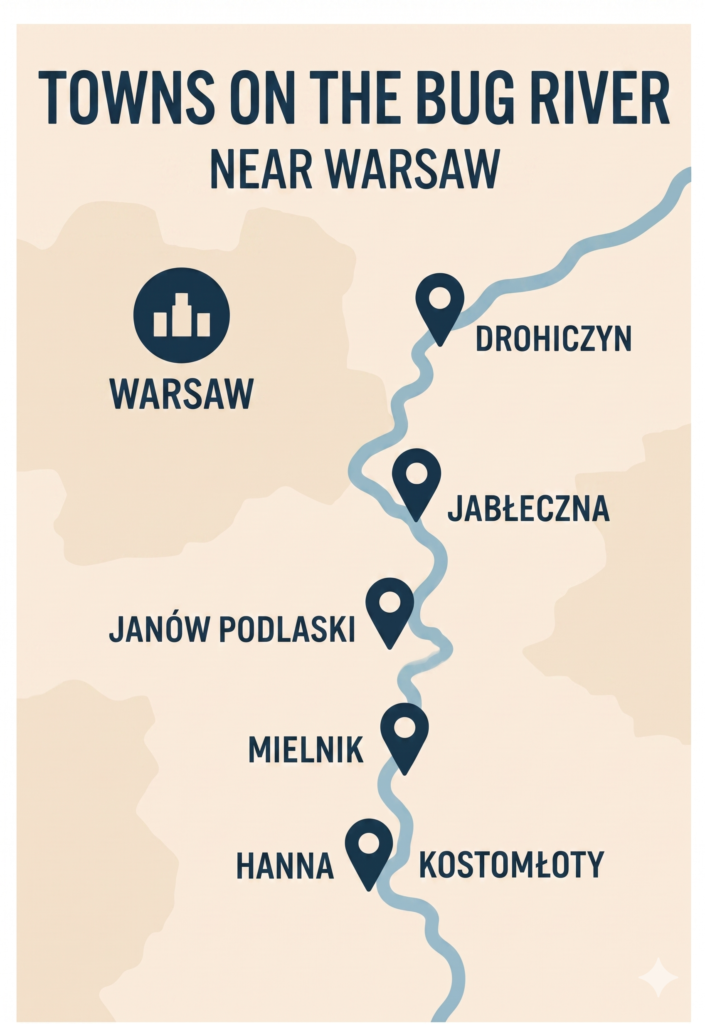
Towns on the Bug River located near Warsaw
Cycling enthusiasts should also be satisfied, as there are numerous cycling routes along the river, including Green Velo, which runs along the Bug through Podlasie and the Lublin region.
8. A Weekend by the Bug River Near Warsaw
A weekend trip to the Bug River can also be a great idea for spending free time not far from Warsaw. Within about an hour’s drive from the city, there are many interesting places worth seeing, including:
- Kamieńczyk — the journey from Warsaw takes about 55–60 minutes. The most important local attractions include:
- the historic part of the town with old fishermen’s cottages,
- beautiful wild beaches on the Bug River,
- kayaking trips on the Bug and Liwiec rivers,
- local fish bars and atmospheric cafés.
- Kuligów — it takes about 50 minutes to get there from Warsaw. Local attractions include mainly:
- a wide sandy beach on the Bug River,
- the seasonal Kuligów–Popowo ferry crossing,
- Nadbużański Landscape Park — an ideal place for walks and cycling,
- a peaceful area, perfect for relaxing in silence and beautiful surroundings.
- Serock — located about 40–50 minutes by car from Warsaw. Tourists appreciate Serock for, among other things:
- a beautiful pier on the Narew and Bug rivers,
- sightseeing cruises on the Zegrze Reservoir,
- a charming market square with cafés and restaurants,
- kayak and pedal boat rentals.
- Brańszczyk — the journey from Warsaw takes about 60 minutes. Noteworthy local attractions include:
- quiet beaches on the Bug River,
- Nadbużański Landscape Park — perfect for hiking,
- the possibility of organizing a kayaking trip in cooperation with local companies,
- wild nature — Brańszczyk is an ideal place for those seeking silence.
A weekend by the Bug is worth spending on relaxation among wild nature, kayaking, fishing, hiking or cycling trips, and sightseeing. There are many ways to spend time by the Bug River, and everyone should find something for themselves.
9. Cottages for Rent by the Bug River
Due to the well-developed accommodation base, finding a suitable cottage, room, or camping spot should not be a problem. If you plan to rent a house during your stay by the Bug, it is worth browsing platforms that mediate such rentals or looking for direct rental offers, paying attention to their standard and the amenities available on site.
If you are looking for a higher standard of accommodation, it is worth considering four cottages for rent in Nadkole, located just 200 metres from the Liwiec River. The cottages are made of natural wooden logs, creating a pleasant indoor microclimate and a cosy atmosphere. They are an excellent option for a family holiday, a trip with friends, or a short weekend getaway. Guests can use the sauna and temperature-controlled swimming pool throughout the year.
If proximity to water is important to you, it is worth considering four cottages for rent in Nadkole, located 200 metres from the Liwiec River. The cottages are made of natural wooden logs, which guarantees a healthy indoor microclimate. The place is recommended primarily for family trips and shorter getaways. Guests can use the sauna and temperature-controlled swimming pool, which are available regardless of the season.
10. Bug River Attractions
The Bug Valley is a region full of various attractions, where every traveller will find something for themselves. Among the inspirations for those planning a stay in this area, it is worth mentioning:
- water activities, including:
- kayaking — the Bug River is perfect for kayaking trips, both for beginners and experienced kayakers. Along the river, for example in the area of Drohiczyn, Mielnik, or Włodawa, there are equipment rental points and companies organizing kayaking trips.
- fishing — the Bug is rich in fish, including pike, catfish, zander, bream, and chub. Anglers should remember that they need the appropriate permit. It is also worth using the help of local guides who know the most attractive fishing spots very well.
- nature and landscapes:
- Nadbużański Landscape Park — a unique protected area in the Bug Valley, full of natural river bends, oxbow lakes, lush vegetation, and rich birdlife.
- The Podlasie Bug Gorge — one of the most picturesque sections of the river.
- the tripoint — near Włodawa there is a meeting point of three countries: Poland, Ukraine, and Belarus, which is a unique place on a European scale.
- islands and oxbow lakes — numerous bends and islands of the Bug are important animal habitats and excellent places for nature observation.
- viewpoints in Drohiczyn and Mielnik — offering beautiful views of the river valley.
- towns and villages with atmosphere and history:
- Drohiczyn — the former capital of Podlasie, picturesquely located on the Bug River. Among the most interesting places in Drohiczyn are Castle Hill, monasteries, Baroque churches, and the Orthodox Church of St Nicholas.
- Mielnik — a small town with ruins on a hill, a chalk mine with an observation terrace, and a historic Orthodox church. There is also a local vineyard in the area.
- Janów Podlaski — known for one of the most prestigious Arabian horse stud farms in the world.
- Kryłów — the main attractions of this town are the castle ruins on the island and the neo-Gothic gate.
One of the most scenic cycling routes in Poland also runs along the Bug Valley — the Bug River Cycling Trail. Along the river, there are numerous agritourism farms where you can try local cuisine and experience the local atmosphere in close contact with nature.